


December 07, 2025
5 min read
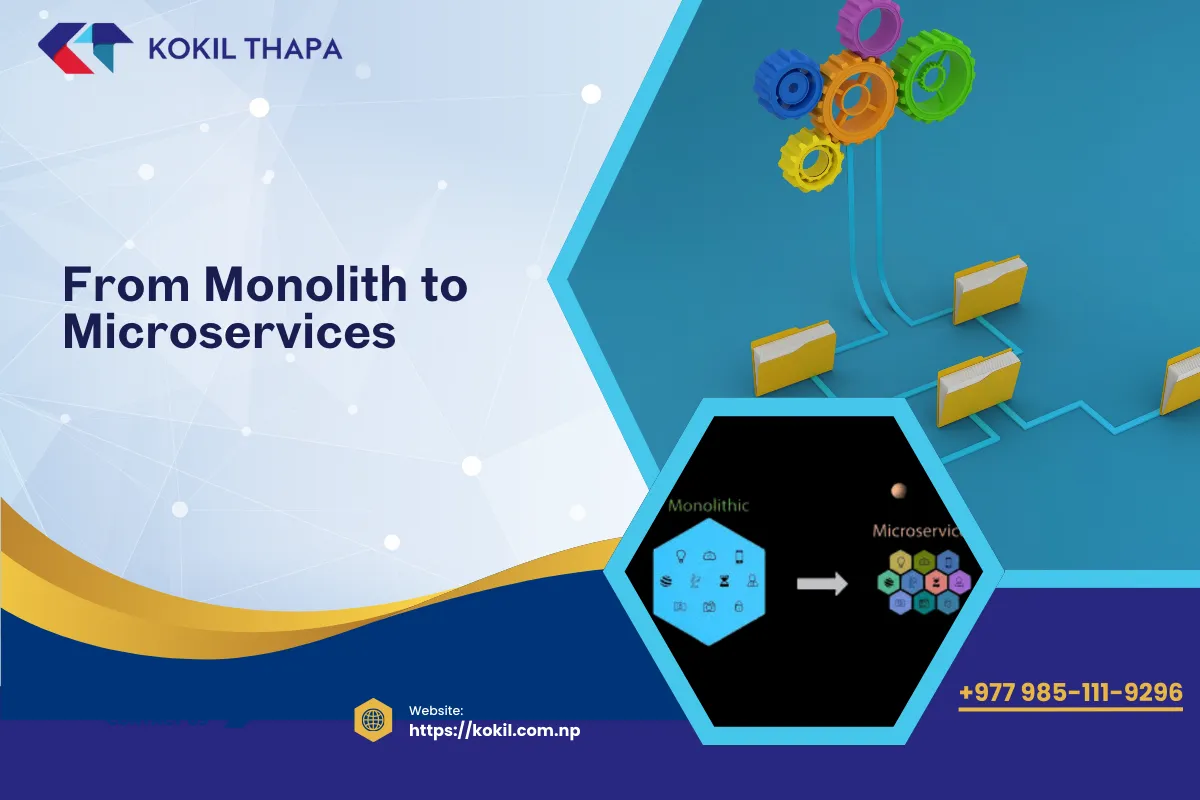
As applications scale, monolithic architectures can become bottlenecks—slowing development, complicating deployments, and limiting performance. Laravel monoliths often start strong but grow into complex, tightly coupled systems where a single bug or slow query affects the entire application. Microservices offer a solution: a distributed system where services are independently deployable, scalable, and maintainable.
But migrating from a Laravel monolith to microservices is not a copy-paste exercise. It requires strategic planning, domain analysis, infrastructure changes, messaging systems, observability, and careful decomposition. This guide provides a detailed, step-by-step migration strategy tailored specifically for Laravel applications in 2025.
1. Why Migrate to Microservices?
Microservices deliver tangible benefits:
Independent Deployment
Deploy one service without redeploying the entire application.
Scalability
Scale only the high-traffic parts (e.g., search, checkout).
Fault Isolation
A bug in one service doesn't crash the entire system.
Technology Freedom
Each service can use the most suitable tech stack.
Faster Development Cycles
Teams can work in parallel on independent services.
Improved Performance
Async communication reduces latency in certain workflows.
Microservices are ideal for SaaS platforms, e-commerce systems, multi-tenant applications, and enterprise applications requiring high uptime and global scaling.
2. When NOT to Use Microservices
Microservices are powerful but not always necessary.
Avoid microservices if:
- Your team is small (1–3 developers)
- The application has low traffic
- Deployment is simple and reliable
- Your domain is not complex enough
- You lack DevOps experience (containers, CI/CD, distributed tracing)
Many companies return to monoliths after misusing microservices.
Migration should be driven by necessity—not trends.
3. Step 1: Assess the Existing Laravel Monolith
Start with a deep audit:
Identify slow modules
- Identify high-traffic routes
- Analyze coupling between modules
- Identify large classes and God objects
- Study database relationships
- Measure performance hotspots using Horizon, Telescope, New Relic
Ask:
Which modules create most bugs?
Which modules need to scale independently?
Which teams need service autonomy?
The migration journey starts with understanding your domain, not writing code.
4. Step 2: Apply Domain-Driven Design (DDD)
Before breaking the monolith, structure it logically.
Domain Decomposition
Identify bounded contexts such as:
Authentication
Orders
Products
Payments
Users
Shipping
Notifications
Search
Analytics
Each bounded context can eventually become a microservice.
5. Step 3: Establish a Strangler Fig Pattern (Safe Migration)
Do not rewrite your whole system.
Instead, use the Strangler Fig Pattern:
Keep the monolith running
Extract one module as a microservice
Route specific requests to the new service
Gradually weaken the monolith until replaced
This reduces risk and spreads migration over time.
6. Step 4: Extract One Service at a Time
Start with the most decoupled module—often:
Notifications
Search
Analytics
Reporting
Do NOT start with Payments or Orders—they are highly coupled.
Example: Extracting Notifications Service
Create a new Laravel/Lumen/FastAPI service
Move notification logic
Expose an API endpoint or message handler
Update monolith to call the service via HTTP / Queue
This begins the microservice ecosystem.
7. Step 5: Define Clear Communication Patterns
Microservices communicate in two ways:
A. Synchronous Communication (HTTP / gRPC)
Ideal for:
Data queries
Real-time API calls
User-facing operations
Tools:
- Guzzle
- Laravel HTTP Client
- gRPC (recommended for low latency between services)
Pros: Simple, predictable
Cons: Adds coupling & latency
B. Asynchronous Communication (Queues / Event Streams)
This is the backbone of scalable microservice architecture.
Use:
Amazon SQS
RabbitMQ
Redis Streams
Kafka
Example event:
order.placed
order.cancelled
product.updated
user.registered
Event-driven architecture drastically reduces synchronous bottlenecks.
8. Step 6: Split the Database into Service-Owned Datastores
One of the hardest parts of microservice migration.
Monolith DB Structure:
All modules share one database
Cross-table dependencies everywhere
Microservice Database Structure:
Each service owns its own schema
No shared tables
No cross-service joins
Use event-based data synchronization:
Service A → emits event → Service B updates its local read model
Why separate databases?
- Prevents data coupling
- Allows independent scaling
- Allows tech freedom (MySQL, Postgres, DynamoDB, Elastic, etc.)
- Avoids distributed transactions
9. Step 7: Replace Internal Calls with API Gateway
Clients should not call services directly.
Use an API Gateway as the entry point.
Tools:
Kong
Traefik
AWS API Gateway
NGINX Ingress (Kubernetes)
Responsibilities:
- Routing
- Authentication
- Rate limiting
- Monitoring
- SSL termination
- Canary deployments
This simplifies client logic and improves security.
10. Step 8: Build Infrastructure for Microservices
Microservices require a strong DevOps foundation:
Docker
Each service runs in its own container.
Kubernetes (K8s)
Handles:
Service discovery
Load balancing
Environment isolation
Self-healing
Horizontal scaling
CI/CD Pipelines
Each microservice must deploy independently.
Observability (HUGE requirement)
Use:
Prometheus
Grafana
OpenTelemetry
Jaeger (distributed tracing)
ELK Stack
Microservices become unmanageable without observability.
11. Step 9: Implement Service Mesh (Optional but Recommended)
When you have 10+ microservices, consider a service mesh:
Istio
Linkerd
Consul
It provides:
- Secure mTLS communication
- Traffic management
- Failure handling
- Tracing
- Canary deployments
- Circuit breakers
Think of it as “network infrastructure for microservices.”
12. Step 10: Gradually Remove Modules from the Monolith
As microservices mature:
Disable module inside monolith
Route traffic to microservice
Archive old code
Update all dependencies
Repeat until monolith becomes:
A smaller core system
orCompletely phased out
13. Common Pitfalls to Avoid in Migration
- Splitting services too early
- No clear domain boundaries
- Deploying microservices without DevOps experience
- Shared database between services
- Too much synchronous communication
- Lack of monitoring
- No governance standards (naming, versioning, API contracts)
Microservices increase complexity—they must earn their place.
14. When Is the Migration Complete?
True microservice maturity includes:
- Independent codebases
- Independent repos
- Independent deployments
- Service-owned databases
- Observability stack
- SRE practices in place
- Event-driven communication
- Versioned APIs
- Horizontal scaling capability
Only then has the monolith evolved into a microservice architecture.
Conclusion
Migrating a Laravel monolith to microservices is a multi-stage transformation requiring careful planning, domain-driven design, asynchronous communication, dedicated datastores, strong DevOps foundations, and continuous iteration. The Strangler Fig pattern, combined with event-driven architecture and modern cloud tooling, provides a safe and scalable path to distributed systems.
For expert assistance in Laravel architecture, microservices migration, and scalable backend engineering, explore services from a
web developer in Nepal,
ecommerce developer in Nepal, and
legal tech developer in Nepal
specializing in modern distributed systems and high-performance cloud applications.
0 Comments
Leave a comment
Your email is not published. Comments appear once they have been read. Sign in to have your details filled in.








