December 14, 2025
4 min read
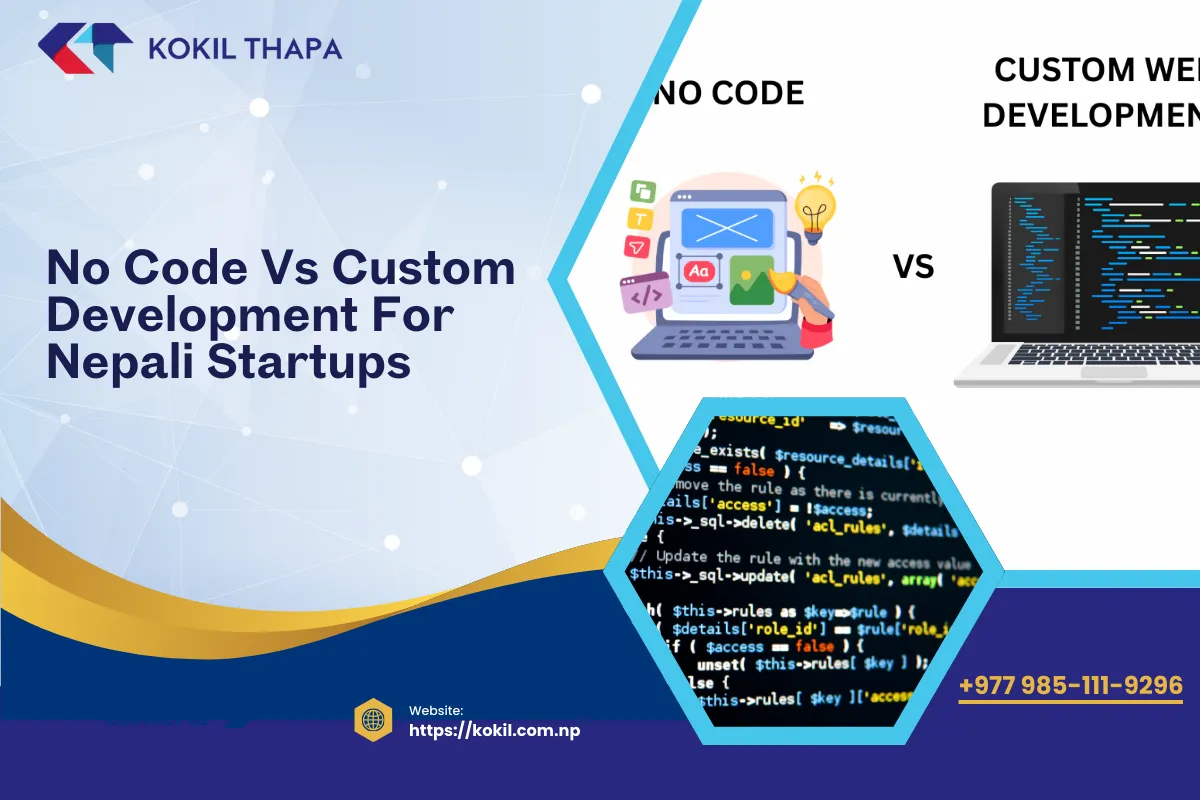
The digital landscape in Nepal is evolving rapidly, and startups are racing to launch innovative solutions quickly. Entrepreneurs face a critical question: should they use no-code platforms for rapid deployment or invest in custom development for a fully tailored solution? Both approaches have their advantages, but the right choice depends on business goals, scalability needs, and long-term vision.
As a Laravel and PHP developer with over 15 years of experience, I’ve helped numerous Nepali startups navigate this decision. In this article, we’ll explore no-code vs custom development for Nepali startups, examining pros, cons, costs, scalability, and which approach aligns best with different business models.
Understanding No-Code Development
No-code development platforms allow entrepreneurs to build web and mobile applications without writing code. They rely on visual interfaces, drag-and-drop tools, and pre-built integrations.
Popular No-Code Platforms
- Bubble: Powerful for web applications with custom workflows
- Adalo: Focused on mobile apps
- Webflow: Great for websites and landing pages
- Airtable + Zapier: Automate workflows and database management
Advantages of No-Code
- Rapid prototyping and deployment
- Lower upfront costs
- Minimal technical knowledge required
- Quick iteration based on user feedback
Limitations of No-Code
- Limited scalability for complex systems
- Vendor lock-in with proprietary platforms
- Performance constraints for high-traffic apps
- Limited flexibility for unique business logic
For Nepali startups testing market fit, no-code is often the fastest way to validate ideas before committing to full custom development.
Understanding Custom Development
Custom development involves building applications from scratch using programming languages and frameworks like Laravel, PHP, React, or Vue.
Advantages of Custom Development
- Complete flexibility and control over features
- Optimized performance and scalability
- Integration with complex third-party services
- Stronger security and compliance control
Limitations of Custom Development
- Higher upfront cost and longer development timeline
- Requires skilled developers or a development team
- Maintenance and updates are ongoing responsibilities
Custom development is ideal for startups aiming to scale rapidly, serve high traffic, or provide unique services that no-code platforms can’t handle.
Cost Comparison: No-Code vs Custom Development
Budget plays a major role in deciding the approach.
No-Code Costs
- Platform subscriptions: $20–$200/month
- Minimal development resources
- Fast to launch, but scaling costs may increase
Custom Development Costs
- Development team: $5,000–$50,000+ depending on complexity
- Hosting, maintenance, security, and updates
- One-time investment, but long-term savings on flexibility
For Nepali startups, no-code offers a low-cost MVP, while custom development provides a robust, scalable long-term solution.
Speed to Market
No-Code
- MVP or initial app: Days to weeks
- Ideal for testing product-market fit
Custom Development
- MVP or initial app: Weeks to months
- Requires planning, coding, testing, and deployment
Speed is critical in competitive markets. Many startups use no-code first, then migrate to custom development as they grow.
Scalability and Performance
No-Code Scalability
- Suitable for small to medium user base
- High-traffic apps may face performance bottlenecks
- Limited backend optimization options
Custom Development Scalability
- Built for growth from day one
- Can handle thousands or millions of users
- Allows database optimization, caching, and cloud-based scaling
For Nepali startups planning long-term growth, custom development ensures performance and stability, especially for SaaS, eCommerce, or legal-tech platforms.
Security and Compliance
Security is a non-negotiable factor for startups handling sensitive data.
No-Code Security
- Security depends on platform provider
- Limited customization for compliance requirements
- Best for low-risk applications
Custom Development Security
- Full control over authentication, encryption, and access control
- Compliance with GDPR, local laws, and industry regulations
- Better protection against breaches and data leaks
For startups in legal tech or eCommerce, custom solutions provide the necessary security and regulatory compliance.
Hybrid Approach: Best of Both Worlds
Some Nepali startups adopt a hybrid approach:
- No-code for MVP to validate market quickly
- Custom development for core functionality, scalability, and long-term growth
This strategy balances speed, cost, and robustness, reducing initial risk while preparing for the future.
Choosing the Right Approach for Your Startup
Ask yourself these questions:
- Is speed-to-market more important than flexibility?
- Do you expect rapid scaling or complex workflows?
- How critical is data security and compliance?
- What’s your budget for development and maintenance?
| Factor | No-Code | Custom Development |
|---|---|---|
| Speed | Fast (days/weeks) | Moderate (weeks/months) |
| Cost | Low upfront | Higher upfront |
| Flexibility | Limited | Full control |
| Scalability | Moderate | High |
| Security | Platform-dependent | Full control |
| Long-term Viability | Medium | High |
For Nepali startups, the best decision often combines both: start with no-code for validation, then scale with custom development.
Conclusion
Choosing between no-code and custom development for Nepali startups requires balancing speed, cost, scalability, and security. No-code platforms accelerate idea validation, while custom development provides a secure, scalable foundation for growth.
For more advanced architecture guidance, tutorials, and hands-on development, you can explore other resources from an expert web developer in Nepal, ecommerce developer in Nepal, and legal tech developer in Nepal who specializes in building high-performance APIs for real-world platforms.
0 Comments
Leave a comment
Your email is not published. Comments appear once they have been read. Sign in to have your details filled in.