


December 14, 2025
5 min read
Let’s be honest—CMS platforms are everywhere, but not all of them deserve your time in 2026. Some are bloated, some are stuck in 2015, and some are absolute beasts if you know how to use them right.
As a Laravel & PHP developer with 15+ years of hands-on experience, I’ve built everything from small blogs to large-scale eCommerce platforms and legal portals. I’ve seen CMS tools rise, peak, and quietly die. This list? It’s not hype-driven. It’s battle-tested.
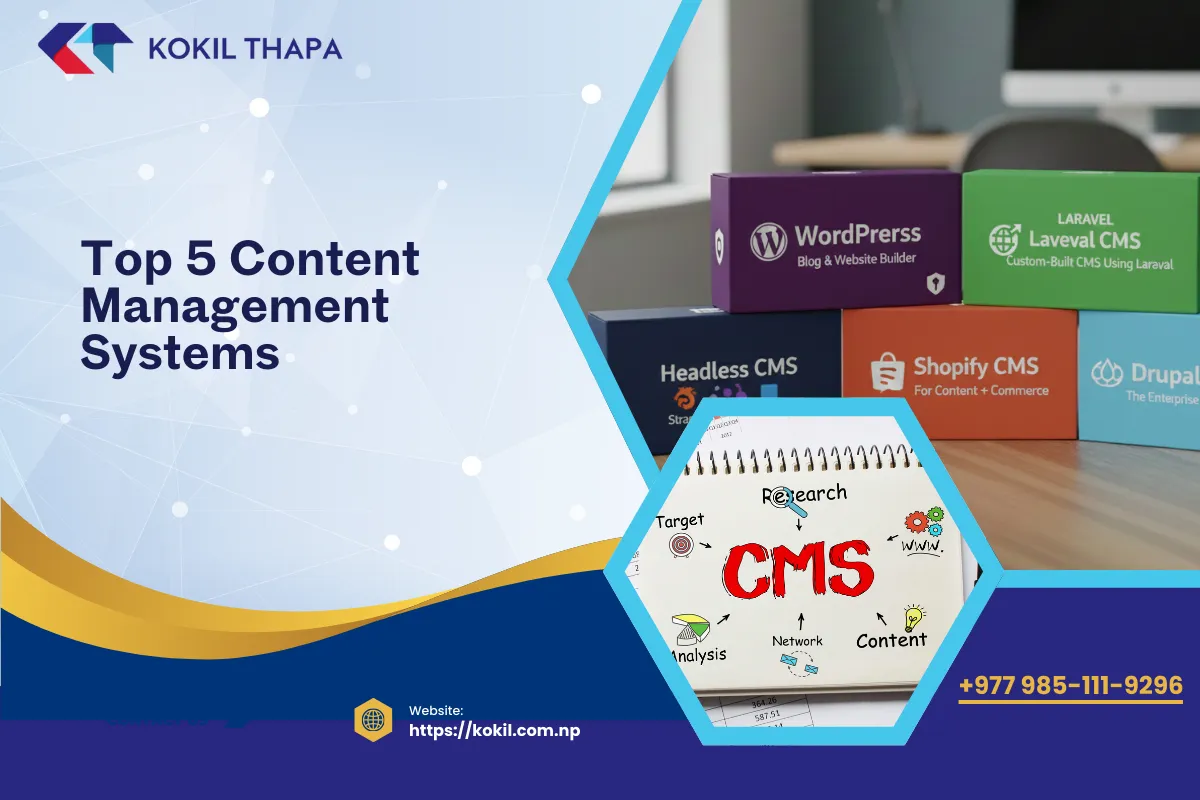
In this article, we’ll break down the Top 5 Content Management Systems in 2026, explain why they matter, who they’re best for, and when you should (or should not) use them.
Let’s get into it
Why Choosing the Right CMS in 2026 Matters More Than Ever
In 2026, a CMS isn’t just about publishing content. It’s about:
- SEO performance
- Speed & Core Web Vitals
- Security & compliance
- API-first architecture
- Scalability for future growth
Pick the wrong CMS and you’ll pay for it later—in performance, maintenance, and missed opportunities.
1. WordPress (Still the King, But Smarter in 2026)
Why WordPress Still Dominates in 2026
Yeah, yeah—WordPress again. But there’s a reason it still runs over 40% of the web.
In 2026, WordPress has matured into a hybrid CMS:
- Classic + Block Editor
- Headless WordPress via REST & GraphQL
- Better performance with modern caching layers
Key Strengths
- Massive plugin & theme ecosystem
- Easy content publishing for non-tech users
- SEO-friendly with tools like RankMath & Yoast
- Works beautifully as a headless CMS
Best Use Cases
- Blogs & content-heavy websites
- Business websites
- SEO-driven marketing sites
Hard Truth
Out of the box, WordPress can be slow and insecure. It needs proper optimization and experienced development—otherwise, it becomes a mess.
2. Laravel CMS (Custom-Built CMS Using Laravel)
Why Laravel-Based CMS Solutions Are Exploding in 2026
This is where serious businesses are moving.
Instead of forcing content into rigid systems, companies are building custom CMS platforms on Laravel, tailored exactly to their workflow.
As a Laravel developer for 15+ years, this is my personal favorite—and for good reason.
Key Strengths
- Full control over architecture
- Rock-solid security
- API-first & headless-ready
- Perfect for complex workflows
Popular Laravel CMS Options
- Statamic
- October CMS
- Fully custom CMS solutions
Best Use Cases
- Legal tech platforms
- Enterprise portals
- SaaS dashboards
- Custom business applications
Hard Truth
Laravel CMS isn’t for DIY beginners. You need an experienced developer—but the payoff is massive.
3. Headless CMS (Strapi, Sanity, Contentful)
Why Headless CMS Is a Big Deal in 2026
Frontend and backend are officially divorced—and honestly, it’s healthier this way.
Headless CMS platforms deliver content via APIs, letting you use:
- Next.js
- Nuxt
- React
- Vue
- Mobile apps
Top Headless CMS Tools in 2026
- Strapi – Open-source & flexible
- Sanity – Real-time collaboration
- Contentful – Enterprise-grade
Key Strengths
- Lightning-fast performance
- Multi-channel publishing
- Developer-first approach
Best Use Cases
- JAMstack websites
- Mobile apps
- Large-scale digital platforms
Hard Truth
Not beginner-friendly. If you don’t understand APIs, deployment pipelines, and frontend frameworks—this will hurt.
4. Shopify CMS (For Content + Commerce)
Why Shopify Is More Than Just eCommerce in 2026
Shopify has quietly evolved into a content + commerce CMS.
With Shopify Hydrogen, Metaobjects, and headless support, it’s no longer “just an online store.”
Key Strengths
- Built-in security & hosting
- Seamless payment integrations
- Scales insanely well
- Perfect for product-driven content
Best Use Cases
- eCommerce websites
- D2C brands
- Content-driven online stores
Hard Truth
Customization is limited unless you go headless or bring in developers. Monthly costs also add up.
5. Drupal (The Enterprise Powerhouse)
Why Drupal Still Matters in 2026
Drupal is not dead. It’s just… selective.
It dominates in industries that need:
- High security
- Complex permissions
- Government-grade compliance
Key Strengths
- Enterprise-level security
- Advanced user roles & workflows
- Strong multilingual support
Best Use Cases
- Government websites
- Universities
- Large organizations
Hard Truth
Drupal has a steep learning curve and higher development costs. Not ideal for small teams.
Quick Comparison Table: Top 5 CMS in 2026
| CMS | Best For | Flexibility | Developer Control |
|---|---|---|---|
| WordPress | Blogs & SEO sites | Medium | Medium |
| Laravel CMS | Custom platforms | Very High | Very High |
| Headless CMS | Modern web & apps | High | High |
| Shopify | eCommerce | Medium | Low–Medium |
| Drupal | Enterprise & Govt | High | High |
How to Choose the Right CMS in 2026
Ask yourself:
- Do I need speed or simplicity?
- Will this scale in 2–5 years?
- Do I need custom workflows?
- Who will maintain it?
If you want long-term growth, don’t choose based on popularity—choose based on architecture.
Final Verdict: Which CMS Wins in 2026?
There’s no “one CMS to rule them all.”
- WordPress → Best for content & SEO
- Laravel CMS → Best for custom, secure, scalable platforms
- Headless CMS → Best for modern multi-channel experiences
- Shopify → Best for eCommerce
- Drupal → Best for enterprise-grade projects
From my experience, Laravel-based CMS solutions offer the best future-proof foundation when built correctly.
Conclusion: Build Smart, Not Trendy
The smartest move in 2026 is choosing a CMS that aligns with your business goals, not just its popularity—WordPress for reach, Shopify for selling, headless CMS for speed, and Laravel-based CMS for full control and long-term scalability.
For more advanced architecture guidance, tutorials, and hands-on development, you can explore other resources from an expert web developer in Nepal, ecommerce developer in Nepal, and legal tech developer in Nepal who specializes in building high-performance APIs for real-world platforms.
0 Comments
Leave a comment
Your email is not published. Comments appear once they have been read. Sign in to have your details filled in.








